
Virtual and Augmented Reality Safety
We have started using Virtual and Augmented Reality in our clubs, but there are a few things to be aware of.
Hey there!
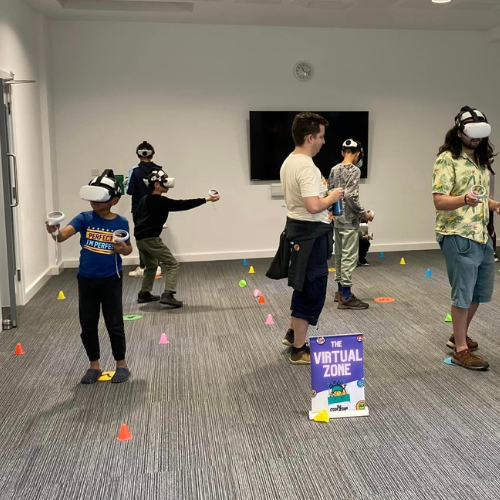
In our in-person clubs we’ve been introducing some exciting ways to code with Virtual Reality (VR) and Augmented Reality (AR)! Our members can now get immersed in their code - but naturally you may be wondering if VR headsets are safe for children to use. Never fear, we’re here to tell you all about how we make sure our sessions are safe and fun and we’re also going to take a peek at some of the research into this area.
What the Research Tells Us
With VR, Short Sessions Are Key!
According to Lee, Kim, and Park (2010), children that were exposed to short VR sessions (meaning under 20 minutes) showed no significant changes in visuomotor coordination. This means that brief, controlled use of VR is unlikely to disrupt children’s natural development.
Plus Stark, Liu, and Rodriguez (2019) found that children from ages 6 to 10 tend to tolerate immersive VR really well. As long as sessions include regular breaks, there were minimal reports of motion sickness.
But What About Augmented Reality?
Augmented Reality is a completely unique experience. VR fully immerses users so that they can’t see the world around them, whereas AR overlays digital content onto the real world. This means that children continue to be able to be aware of their surroundings while interacting with the content.
Since AR uses physical environments, it can reduce disorientation that sometimes comes from the use of fully immersive VR. AR is really suitable for educational settings where being aware of the world around you is crucial!
Research from Johnson and Miller (2023) suggests that AR can increase engagement and promote learning, and comes with even fewer side effects than VR. Children often report less symptoms of nausea and higher comfort levels with AR.
About Meta Quest 3
In our clubs, we use the Meta Quest 3 VR headset. The Meta Quest is really special because it supports immersive VR and also includes advanced AR capabilities! This means that we can support a range of different educational activities and comfort levels in our clubs.
Addressing Manufacturer Guidelines
You may have seen some VR headsets (such as the Oculus Quest 2) often advise a minimum age of 13. However, it’s important to note that these guidelines are usually based on the age requirements for social media instead of being based on concerns for health and safety. Our approach is guided by research and best practices, not commercial age limits.
Our Commitment to Safety and Enrichment
At our sessions, we’re dedicated to ensuring that your child’s experience with both VR and AR is safe, engaging, and educational. Here’s what you can expect from our clubs:
Time-Limited Sessions
Based on the research, we ensure that each VR or AR session lasts for no longer than 20 minutes and is followed by at least a 20 minute break. This minimises the risk of prolonged exposure, and helps to make sure our members remain comfortable.
Supervised Use
Our staff are trained in the safe use of VR headsets. During every session, our staff will monitor the activity and pause it immediately if your child expresses any form of discomfort.
Balanced Educational Content
We carefully design our VR experiences to encourage creativity and independent problem solving. From puzzles in virtual worlds to engaging with digital overlays in AR, members of The Code Zone are encouraged to learn and explore in a safe environment.
Open Communication With Parents
We believe in the importance of staying in touch with parents and we’ll always keep you up to date about what’s going on in our clubs. If you have any concerns, thoughts, or suggestions please don’t hesitate to get in touch!
Where Can I Find Out More?
We’re not the only ones who see the potential that VR headsets hold. Leading organizations and experts in the field support the thoughtful use of VR and AR:
- American Academy of Pediatrics (AAP): The AAP has noted that high-quality, interactive digital media can offer significant developmental benefits when used appropriately.
- Virtual Reality Society (VRS): The VRS highlights that short, supervised VR sessions can enhance spatial reasoning and interactive learning without adverse effects.
- International Journal of Human-Computer Interaction: Research published here supports the notion that AR, with its less immersive nature, often results in fewer side effects, making it a safe tool for educational purposes.
For further reading, check out these resources:
- American Academy of Pediatrics: Media and Young Minds
- Virtual Reality Society on VR Safety and Best Practices for Children
- Johnson, A., & Miller, B. (2023). The Effects of Augmented Reality on Child Learning and Comfort. International Journal of Human-Computer Interaction, 39(2), 200-210.
- Meta. (2023). Meta Quest 3: Redefining Augmented Reality. Retrieved from https://www.meta.com/quest3
In Conclusion
The research tells us that VR and AR are safe tools for children to use as long as they stick to short, controlled sessions. This means that we’re able to offer even more fun and engaging methods of learning how to code! We always prioritise your child’s safety which is why our approach to VR and AR use is informed by research into the area.
If you have any further questions please do get in touch! We’re always happy to chat and value your feedback so that we can make sure that our sessions are equal parts fun and safe.
We’ll see you in club for your next journey into Virtual Reality!
About The Code Zone
The Code Zone teaches children aged 6 to 16 to code by building their own games. Outside the UK that is the Game Dev Academy: self-paced, so a child works at whatever hour suits them in any time zone, with a background-checked, STEM-certified mentor answering by text and video message.
It started in Britain, where in 2026 it was the highest-placed coding club in Club Hub UK's Top 100 Children's Activity Providers, and in 2025 received the Autism Inclusion Award from the National Autistic Society, the UK's leading autism charity. More than a third of members are autistic or have ADHD, based on what parents tell us when they join.
More like this
The blog is in two halves. Guides are the evergreen explainers written by the mentors who teach the clubs, covering the questions parents actually ask: what comes after Scratch, how to support a coding-mad child when you cannot code yourself, and what works for autistic and ADHD children.
Club news is the other half, and it is where posts like this one live: game jams, Minecraft builds and weekly roundups, written up by whoever ran the session. Neither is marketing. If you want to know what the work actually looks like before you sign up to anything, club news is the more honest read of the two.
Creating an account is free and we do not ask for card details. Create a free account, see what it costs, or read about support for neurodivergent children.


