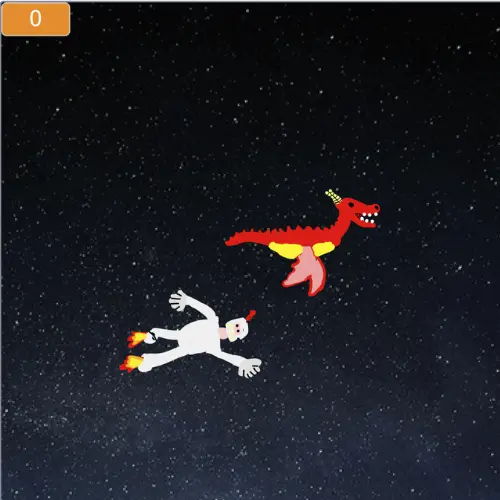
See Arabella's AMAZING Ace Pilot Game below - full of colour and her own mods
Welcome back to another week of Game Dev Club! This week, my Modder members are working on Ace Pilot; a flying simulator where the player has to navigate the skies trying to avoid enemy bullets. Last week, our Guided Hack involved a new spawning system which included enemy waves. This week, we are focusing more on cosmetics and animations rather than game mechanics - though they are all linked together to create the polished and finished game!
Today's Guided Hack is adding a smoke effect which appears on the player's plane when they get struck my an enemy pip. The smoke becomes a life indicator which becomes larger and darker the more hits the player takes - neat! To do this we create a smoke asset as well as a smoke variable - with this we can them set the smoke to appear and follow the player's plane's position should our lives every drop below 3. The size is determined by how much life we have; the less lives we have the larger the smoke is. To give the smoke a bit of life and animation, we create a destroy_smoke function which randomly chooses some of the smoke's pixels within its asset to delete. This creates the effect of the smoke moving as it repeats itself, a fun way to do animation without the animation coding blocks
We also had the chance to do some of our Python Coding Skills this week include how to create a sprite within Python. One of my members took this coding skill to the next level by adding as many sprites as they could; practising the written code over and over whilst also exercising their pixel art skills in the asset editor. Well done!
Until next time, happy coding!
About The Code Zone Academy
Posts like this one are written by the mentors, about what members have been building. The Game Dev Academy has no fixed session time: a new build goes up every week and a child opens it whenever they are ready, with a STEM-certified mentor answering by text and video message when they get stuck.
Children build their own games rather than following a set course, starting in Scratch. Levels move down as readily as up, and staying where you are is a perfectly good outcome. Every mentor is background-checked and STEM-certified.
The blog is in two halves. Guides are the evergreen explainers written by the mentors who teach the clubs, covering the questions parents actually ask: what comes after Scratch, how to support a coding-mad child when you cannot code yourself, and what works for autistic and ADHD children.
Club news is the other half, and it is where posts like this one live: game jams, Minecraft builds and weekly roundups, written up by whoever ran the session. Neither is marketing. If you want to know what the work actually looks like before you sign up to anything, club news is the more honest read of the two.